


From the perspective of a GTM partner advising global projects entering Korea, 2025 was less a year of expansion and more a year of structural clarification.
On the surface, inbound demand from overseas teams remained steady. Marketing execution, research production, and localization efforts continued at scale. The ecosystem appeared active. Beneath that surface, however, Korea’s internal liquidity mechanics and retail behavior shifted in ways that materially change how the market should be approached.
The defining change was not cyclical sentiment. It was structural. The feature that once made Korea uniquely attractive to global token projects — concentrated, exchange-driven liquidity hype — weakened. In its place, leverage began migrating toward regulatory positioning, stablecoin infrastructure, onboarding rails, and revenue-backed utility.
For teams treating Korea as a volatility amplifier, this shift is strategic.
1. Exchange Strategy: From Scarcity to Dispersion
One of the clearest signals emerged at the exchange level.
Upbit continues to hold roughly 70 percent market share, preserving structural dominance. In practical terms, asset visibility in Korea is still heavily mediated through Upbit. However, during 2025 both Upbit and Bithumb accelerated new listings at a higher pace than prior years.
The critical observation is not the increase in listings itself. It is that listing expansion no longer generated concentrated post-listing overheating — the dynamic that historically drew global attention.
In previous cycles, strict listing selectivity created scarcity. Scarcity concentrated liquidity. Concentrated liquidity amplified volatility and reinforced Korea’s symbolic pricing power. As listing frequency increased in 2025, liquidity dispersed structurally and the scarcity premium diluted. Korean listing-driven volatility lost part of its signaling effect.
This evolution appears rational. Ongoing regulatory discussions, structural developments involving Naver–Dunamu, and adjacent expansion into stablecoin and financial infrastructure initiatives suggest exchanges are optimizing for sustainability and regulatory resilience rather than volatility optics. But the strategic consequence is clear: Korea’s identity as a concentrated liquidity epicenter has softened.
2. Retail Participation Increased. Risk Appetite Contracted.
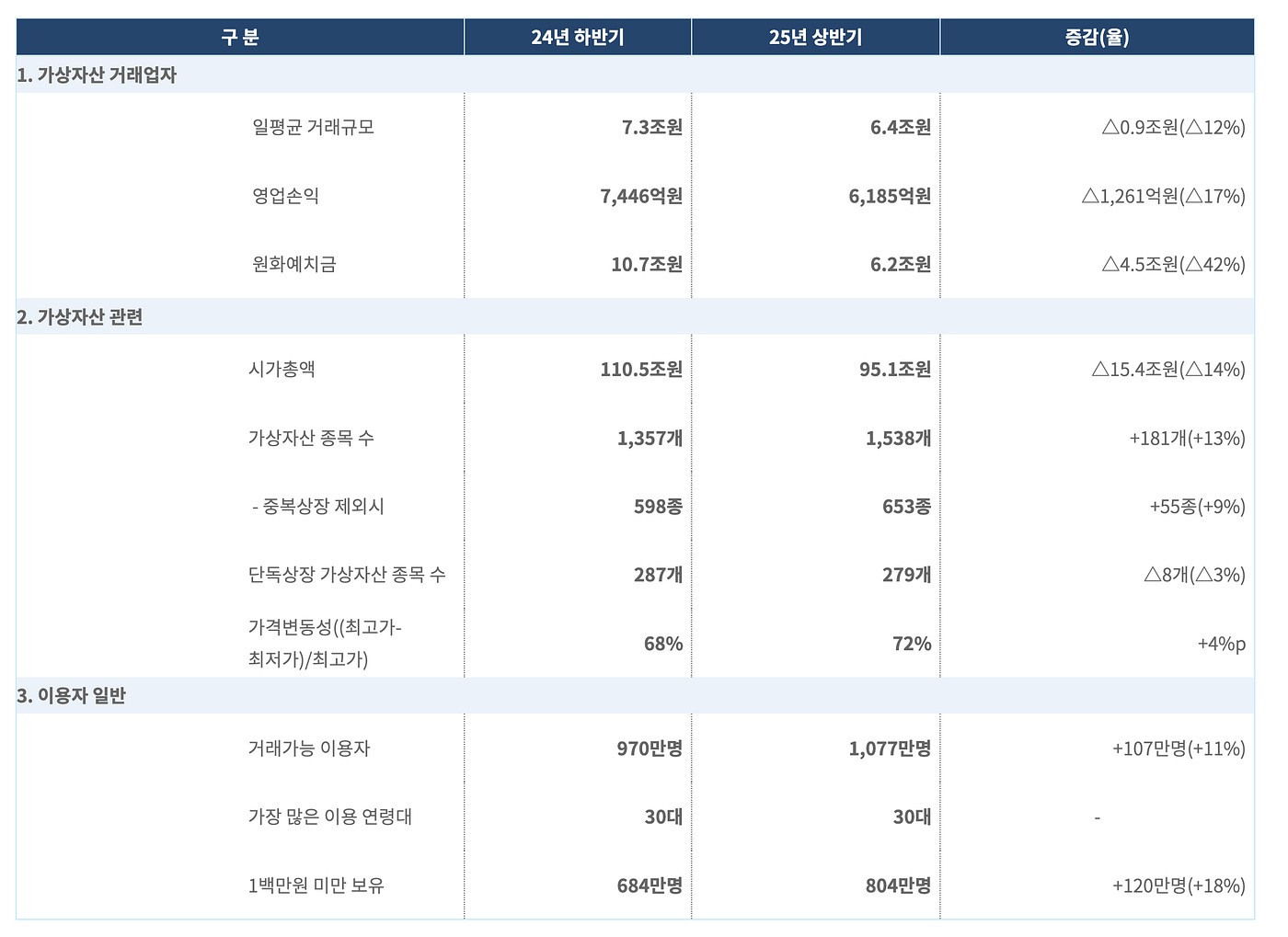
Financial Services Commission data from the first half of 2025 indicates that the number of tradable users increased to approximately 10.7 million, while average daily trading volume declined and aggregate deposits decreased.
User count rose. Capital velocity fell.
Retail did not exit. Retail recalibrated.
Behavior shifted toward reward extraction with minimized exposure. Airdrops were farmed and monetized quickly. Holding periods shortened. Capital-at-risk participation declined. The dominant behavioral shift moved from “buy early and hold for asymmetric upside” to “capture incentive, reduce downside.”
This is not evidence of apathy. It reflects rational adaptation to compressed upside distributions and repeated post-TGE sell pressure. Korean retail remains present — but structurally more defensive.
3. The Launch Template Lost Signaling Power
The standard token lifecycle — venture raise, product launch, points campaign, TGE, exchange listing — previously functioned as a repeatable liquidity engine in Korea.
The launch template lost signaling power.
Market participants increasingly decoupled venture backing and incentive campaigns from assumptions of durable value creation. The template began to signal predictable sell pressure rather than opportunity.
As a result, project outcomes bifurcated. Teams demonstrating revenue visibility, sustained user retention, and coherent token economic design accumulated structural trust. Projects optimized primarily for marketing amplification and incentive engineering generated attention but struggled to convert it into durable liquidity. The middle category — projects sustained by narrative momentum alone — thinned materially.
4. Attention Is Not Liquidity
Short-form incentive-based marketing continues to generate reach and engagement metrics. It does not reliably convert into durable capital.
Earlier airdrop cycles required at least minimal product interaction and ecosystem engagement, fostering partial alignment. By 2025, the dominant flow compressed into exposure, reward, and rapid monetization. This compression eroded long-term holder formation and reinforced short-termism.
Attention is not liquidity.
For projects entering Korea, equating visibility with capital commitment has become a strategic miscalculation.
5. A Self-Reinforcing Feedback Loop
Retail defensiveness creates a feedback loop: faster selling reduces incentive allocations, lower incentives weaken conviction participation, and projects increasingly rely on viral tactics to compensate — reinforcing even faster selling behavior.
The system entrenches short-term optimization.
Recent disengagement from engagement-farming platforms reflects incentive fatigue rather than simple platform decline. The marginal reward for participation no longer justifies the effort for many users.
6. The Absence of Broad Alt Expansion
The absence of a broad-based alt expansion phase amplified these dynamics. Without a period where upside diffuses across participants, capital converges into narrower, higher-volatility niches. Narrative cohesion weakens and participation becomes transactional rather than ecosystem-driven.
Korea’s Telegram-centric Web3 community appears to have passed its speculative romantic phase. For many participants, crypto activity now resembles tactical income optimization rather than long-term ecosystem alignment.
7. Structural Opportunity: Onboarding Leverage
Despite these shifts, Korea’s long-term structural opportunity remains substantial.
Highly active crypto-native participants likely number under fifty thousand. Registered exchange users exceed ten million. The onboarding gap remains significant.
KRW-denominated stablecoin development could become a structural catalyst. If domestic fintech and large technology platforms integrate wallet and settlement infrastructure into mainstream products, crypto exposure may migrate from speculative subculture to embedded financial utility.
At that point, Korea would function less as a trader-driven market and more as an infrastructure-driven onboarding market.
In parallel, revenue-generating protocols are increasing, regulatory clarity is improving incrementally, and revenue-sharing token structures are becoming more viable. These shifts support valuation frameworks anchored in measurable cash flow rather than narrative expansion alone.
Conclusion
The Korean crypto market in 2025 did not contract. It matured under constraint.
Liquidity concentration weakened. Retail participation persisted but became more defensive. Launch templates lost automatic credibility.
Leverage migrated.
For global projects, Korea is no longer primarily a volatility amplifier.
It is increasingly a selective infrastructure market.
The strategic question for 2026 is not whether hype returns.
It is who adapts to this post-hype equilibrium first.
Legal & Disclosures
Disclaimer
This publication is for informational and research purposes only and does not constitute investment, financial, or legal advice, nor a recommendation to buy, sell, or hold any asset.
All analysis reflects publicly available information and reasonable assumptions at the time of writing and may change as market or regulatory conditions evolve.
This research was prepared independently and without compensation from any issuer or affiliated party. Readers are solely responsible for their own investment decisions. Exilist assumes no liability for any losses resulting from reliance on this publication.
Terms of Use
Exilist permits the fair use of its research materials for non-commercial and informational purposes, provided that the original meaning and analytical context are not altered.
When referencing or citing this publication, clear attribution to Exilist is required.
Any republication, translation, restructuring, commercial distribution, or derivative use of this material, in whole or in part, requires prior written consent from Exilist.
Unauthorized commercial use, misrepresentation of analytical conclusions, or redistribution without proper attribution may result in legal action.