


Aztec’s listing on Upbit’s KRW market is notable not simply as another token listing, but as a rare moment where a major Korean exchange explicitly embraced privacy infrastructure as a legitimate sector.
Following Upbit’s announcement on February 19, trading for AZTEC officially began on February 20 at 16:30 KST. Given Korea’s historically conservative stance toward privacy-focused assets, this move stands out. It also naturally invites comparison with Zama, another privacy-oriented project operating at the infrastructure layer.

But Zama sits at an uncomfortable intersection between ambitious cryptographic theory and practical, deployable infrastructure. Kyle Samani’s decision to step down from daily operations at Multicoin Capital while remaining on Zama’s board only intensified debate around its long-term prospects.
This article evaluates, from an operational perspective, whether Zama can realistically become lasting infrastructure, and where it stands today.
1. Why Aztec’s Upbit Listing Matters
Korean exchanges have historically been cautious with privacy-related assets. Regulatory risk (AML concerns), internal compliance standards (traceability), and limited retail appetite for infrastructure narratives all act as barriers.
Yet Upbit opened AZTEC simultaneously across KRW, BTC, and USDT markets. This implies at least two internal conclusions:
Aztec was categorized not as an anonymous payment coin, but as a privacy Layer 2 on Ethereum.
Exchanges increasingly recognize that institutional on-chain activity will inevitably require privacy primitives.
With privacy infrastructure now appearing on major exchange listing tables, the natural comparison becomes ZK-based systems (Aztec) versus FHE-based systems (Zama).
2. Zama and FHE: Breakthrough or Expensive Experiment?
In February 2026, crypto markets revealed a widening gap between technical sophistication and commercial validation.
Zama, widely regarded as a pioneer of Fully Homomorphic Encryption (FHE), launched its token on February 2. Despite private valuations exceeding $1B, its fully diluted valuation quickly settled around ~$200M in public markets.
This gap signals that what venture capital once framed as the “holy grail of cryptography” is now being priced as an expensive experiment: technically impressive, but still commercially unproven.
Samani’s pivot toward AI and robotics suggests Zama is increasingly positioned not as a Web3 project, but as future AI security infrastructure. At the same time, it highlights how difficult this asset remains for crypto-native markets to digest.
1) The Valuation Collapse

Trading at roughly $200M FDV after unicorn-level private rounds implies one of two things: either there is insufficient retail liquidity to absorb institutional exit supply, or the market is implicitly rejecting the feasibility of the technology.
Blockchain security depends on attack costs exceeding potential rewards. At this valuation, staking-based security budgets become questionable. If network takeover costs fall into the tens of millions, enterprises will hesitate to entrust sensitive data.
Zama’s burn-and-mint token model compounds this issue. Fees are burned, while validators receive newly minted tokens. Lower market caps directly translate into weaker economic security.
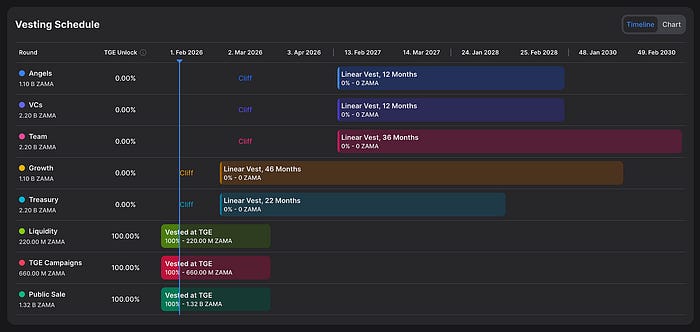
There is also a structural paradox. As FHE becomes more efficient, fewer tokens are required per computation, reducing token demand. At the same time, token price volatility makes enterprise cost forecasting difficult, pushing companies toward predictable cloud pricing models.
Add potential long-term VC sell pressure, and price recovery becomes even harder. In short: the technology may be elegant, but the economic container is fragile.
2) Is the Technology Actually Usable?
Even after major performance improvements, FHE remains orders of magnitude slower than plaintext computation. In absolute latency terms, operations that complete in seconds under normal conditions can take hours under FHE.
If the core promise of the AI agent era is real-time responsiveness and autonomous interaction, FHE fundamentally collides with that trajectory.
Proponents argue ASIC acceleration will eventually resolve this. However, developing custom silicon requires massive capital, multi-year timelines, and manufacturing priority that is highly unlikely at Zama’s current market scale. Major players like NVIDIA or TSMC have little incentive to allocate dedicated production lines for FHE-specific chips. Software optimization alone cannot overcome these physical constraints.
Meanwhile, market momentum favors solutions that are “secure enough and significantly faster.”
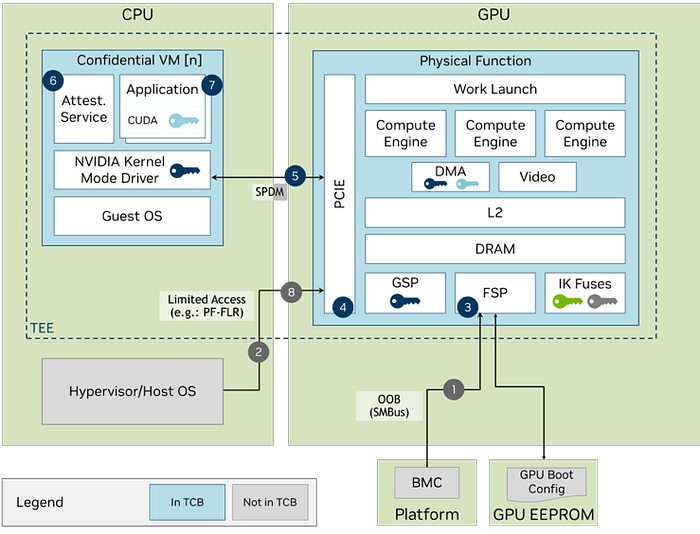
TEE (Trusted Execution Environments): GPUs such as NVIDIA H100/B200 already support confidential computing with only ~1.1–1.5x overhead versus plaintext. Enterprises consistently prioritize speed and cost over fully trustless privacy.
MPC (Multi-Party Computation): MPC has reached near-production maturity, and many teams already combine MPC with ZK proofs to solve privacy problems today.
Compared to FHE’s massive computational overhead, these approaches offer deployable security right now.
More critically, FHE struggles with composability. In agent-based systems where outputs from Agent A become inputs for Agent B, applying FHE across every step causes computational costs to grow exponentially.
Most users will not pay 100x more for privacy.
Taken together, this creates a real risk that Zama becomes the most technically complete solution in the market, and the one nobody actually uses.
3. Interpreting Kyle Samani’s Exit

Samani’s resignation carries far more meaning than a routine leadership change.
Shortly before stepping down, he published (and later deleted) tweets questioning the future of Web3 and dApps, reframing blockchains not as application platforms but merely as asset ledgers. He cited Solana and Zama as rare exceptions.
From his perspective, the true battleground is no longer Web3, but AI, robotics, and longevity technologies, where personal data security becomes existential. In that framing, FHE becomes a mathematical foundation for AI-era privacy, and Zama is repositioned not as a crypto project, but as future security infrastructure.
Still, this move can also be interpreted less charitably. Some view it as an attempt to preserve strategic flexibility around a heavily concentrated portfolio position. Multicoin has previously faced criticism for overexposure to single narratives, and Samani’s advocacy may reflect confirmation bias rather than dispassionate analysis.
It is also possible that his conviction in Zama stems more from technical aesthetics than commercial realism. He has historically favored ambitious engineering narratives centered on cryptographic elegance, even as several of those narratives collapsed in practice.
Whether FHE can escape that same fate remains an open question.
4. And Yet
In the 1990s, streaming video over dial-up sounded absurd. Today, real-time 4K streaming is trivial.
FHE sits in a similar place today.
Despite optimization efforts, throughput still hovers around the 20–30 TPS range, and latency remains extreme. In an AI agent economy defined by real-time responsiveness, this directly conflicts with system assumptions.
Judging FHE purely on today’s metrics would be equivalent to declaring the death of streaming based on 1990s modem speeds. Zama argues this gap can be closed via algorithmic breakthroughs and infrastructure evolution.
1) Zama’s Three-Stage Technical Roadmap
Phase 1: Software Optimization
Using TFHE-rs and Concrete, Zama reports 10–20x improvements in specific operations.
Phase 2: Hardware Acceleration
Zama targets FHE-specific ASIC development around 2027–2028. However, without preferential access to NVIDIA or TSMC, this remains a long-term aspiration rather than a near-term solution.
Phase 3: Hybrid Architecture (FHE + MPC + ZK)
Zama proposes FHE for computation, MPC for key management, and ZK for input validation, with fhEVM acting as a coprocessor to offload encrypted computation.
This is a pragmatic engineering approach rather than ideological purity.
2) Early Signals of Adoption
Zama is not operating purely at the white paper level.
OpenZeppelin is collaborating with Zama on ERC-7984, a confidential token standard that lowers developer friction through familiar abstractions.
In January 2026, Zama conducted a sealed-bid on-chain auction with over 11,000 participants and ~24,700 encrypted bids, structurally eliminating frontrunning and sandwich attacks.
While still experimental, this demonstrated that FHE can function in live environments.
Conclusion
Zama’s current market performance is undeniably weak. Prolonged suppression at these levels directly weakens network security budgets and erodes ecosystem confidence. Market skepticism is therefore rational.
Yet Zama also deserves credit for shipping real systems rather than relying solely on theoretical promises.
Among privacy technologies, FHE offers the strongest cryptographic guarantee: computation on encrypted data without exposing plaintext. TEE and MPC achieve practicality by accepting trust assumptions, whereas FHE minimizes them entirely.
TEE already integrates directly into modern AI infrastructure, which is why it will likely dominate near-term enterprise adoption. For FHE, the bottleneck is not cryptography but speed and resource cost.
If Zama can compress these constraints into an industrially acceptable range, FHE could eventually surpass TEE and MPC across high-sensitivity sectors such as medical data, financial models, and identity infrastructure. This matters because sensitive data industries ultimately demand structural security, not compromise-based security.
Another important signal emerged when Upbit listed Aztec across KRW, BTC, and USDT markets. For a Korean exchange historically cautious toward privacy assets, this suggests a shift: privacy is beginning to be treated as infrastructure rather than taboo.
In summary, Zama’s present reality is harsh, but the technical logic of FHE remains intact. The real question is not whether the cryptography works, but whether the engineering can deliver performance at industrial scale.
The decisive factor is not the direction of the technology.
It is execution.
The future of FHE will be determined not by cryptography papers, but by engineering discipline.
Legal & Disclosures
Disclaimer
This publication is for informational and research purposes only and does not constitute investment, financial, or legal advice, nor a recommendation to buy, sell, or hold any asset.
All analysis reflects publicly available information and reasonable assumptions at the time of writing and may change as market or regulatory conditions evolve.
This research was prepared independently and without compensation from any issuer or affiliated party. Readers are solely responsible for their own investment decisions. Exilist assumes no liability for any losses resulting from reliance on this publication.
Terms of Use
Exilist permits the fair use of its research materials for non-commercial and informational purposes, provided that the original meaning and analytical context are not altered.
When referencing or citing this publication, clear attribution to Exilist is required.
Any republication, translation, restructuring, commercial distribution, or derivative use of this material, in whole or in part, requires prior written consent from Exilist.
Unauthorized commercial use, misrepresentation of analytical conclusions, or redistribution without proper attribution may result in legal action.