


The landscape of KRW stablecoins in Korea is shifting.
The core question has moved from “what coin gets built?” to “which combination of players assembles the winning puzzle?”
Following clearer regulatory guidance in 2025, the idea of a single company launching and dominating a KRW stablecoin is increasingly unrealistic. Instead, the market is shaping into a multi-party, consortium-based ecosystem where banks, fintechs, big tech platforms, and exchanges each play distinct roles.
A defining catalyst of this shift has been the strategic merger between Naver Financial and Dunamu (operator of Upbit) — a classic textbook example of the type of coalition that could lead the KRW stablecoin era.
This report maps the evolving player landscape across four major groups, analyzing their motivations, constraints, and partnership prospects in the context of Korea’s developing regulatory and market environment.
Regulation Creates a “Role Map”
Emerging regulatory frameworks are implicitly outlining what each category of player can and cannot do.
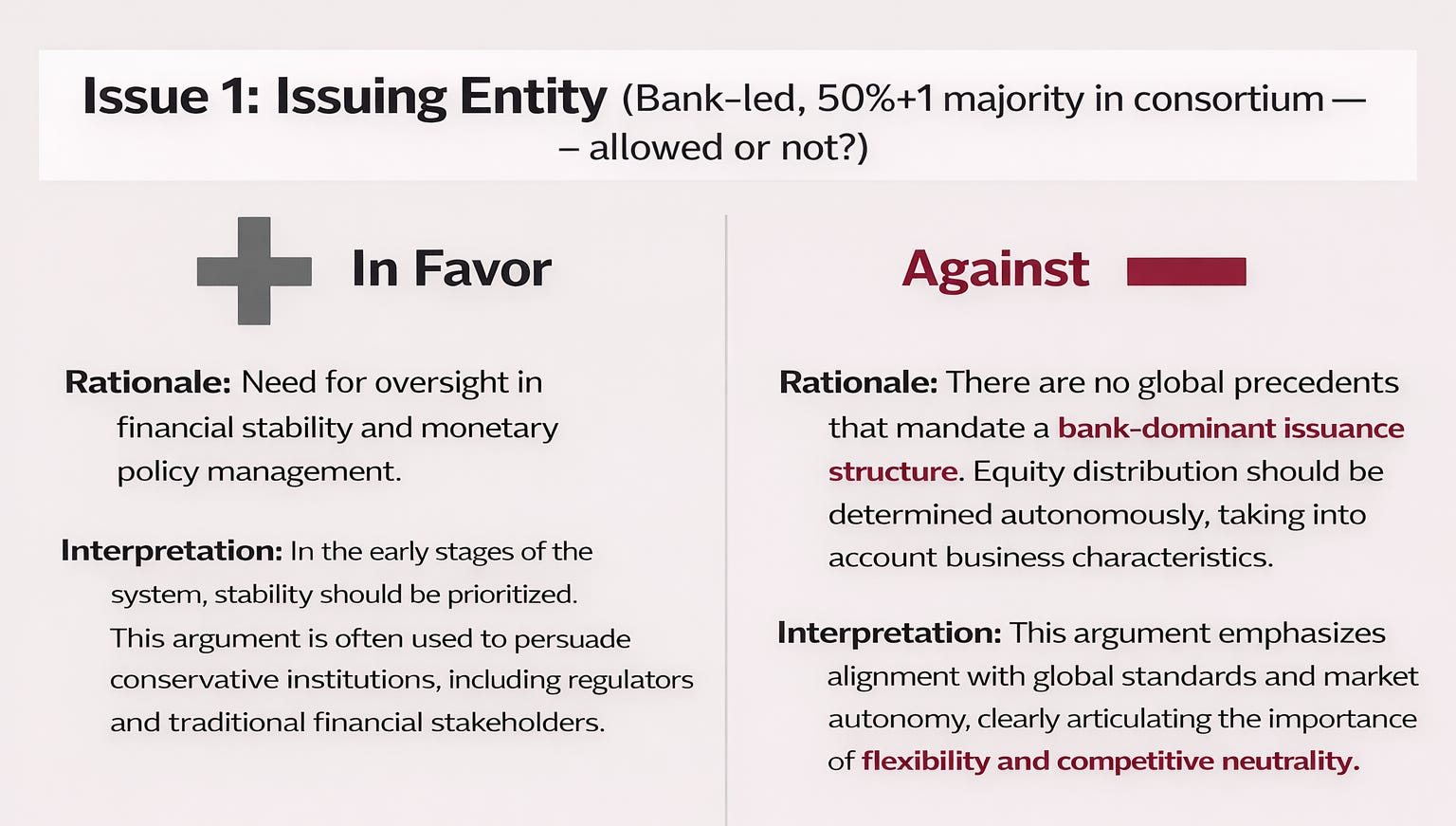
Contrary to early rumors of a strict “51% bank ownership requirement” for issuers, regulators have clarified that such a rule is not formally adopted. Instead, the FSC has signaled openness to non-bank participation if certain conditions are met — aligning with global norms rather than rigid, bank-exclusive models.
The broad policy direction now emphasizes:
Consortium issuance with multiple actors
Full reserve backing
Banking-level prerequisites for trust and solvency
Regulatory inspection and command authority
Stress testing and central bank coordination for systemically important stablecoins
These structures are not relaxed in substance — they simply recognize that inclusiveness need not mean less rigor. The basic regulatory message boils down to:
“No single entity should control issuance to the exclusion of others; robust institutional checks are essential.”
This implicitly draws a role map: banks bring trust and capital, fintechs offer agility and UX, big tech contributes distribution scale, and exchanges supply liquidity and infrastructure.
Four Player Groups & Their Strategic Profiles
1) Banks: Trust & Capital, But Strategic Dilemma
Banks’ public stance is anchored in financial stability and consumer trust. Given that a KRW stablecoin functions similarly to a near-money instrument, banks emphasize anti-money laundering compliance, reserve management discipline, and systemic safety.
In the legislative process, banks have framed themselves as the natural issuers, highlighting:
Capital strength
Regulatory compliance capabilities
Public trust in managing fiat-linked assets
Behind this posture, banks are vying to retain control of payment and settlement flows as digital currency markets evolve. Their influence over foundational rails — deposit management, settlement networks, credit flows — makes their involvement pivotal.
Banks’ strengths include:
Established regulatory status
Massive capital and stable balance sheets
Public confidence as custodians of fiat value
Existing payment and account infrastructures
However, weaknesses persist:
Lower innovation speed compared to tech platforms
Limited digital UX experience
Legacy system constraints
Regulators have even acknowledged that a bank-only issuance model might undermine innovation competitiveness. As a result, banks are likely to seek strategic partnerships with technology and platform players while retaining governance influence.
2) Fintech & PG (Payment Gateways): Agile Innovators with Trust Gaps
Fintech firms and payment gateways are primarily focused on payments innovation and user experience. They see KRW stablecoins as a means to:
Reduce transaction friction
Enable fast, low-cost settlement
Automate clearing via smart contracts
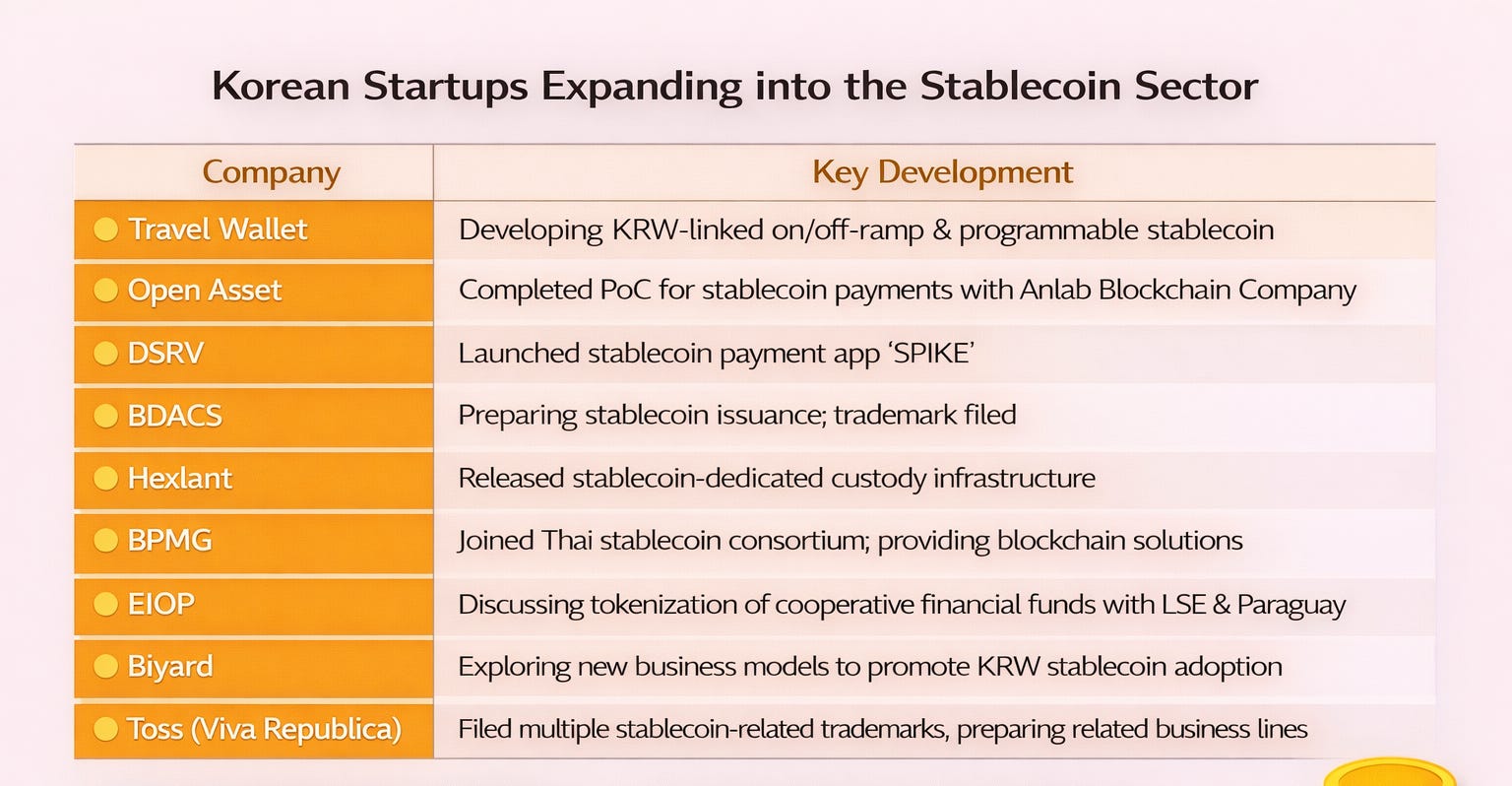
For many fintechs, the underlying opportunity is broader:
circumvent entrenched fee structures and establish new market positions in digital payments and financial flows.
Strengths of fintech players include:
Rapid product iteration
Consumer-centric UX design
Competence in mobile and digital interface development
Experience with cross-border fintech solutions
Weaknesses include:
Limited capital compared to banks
Weaker consumer trust around custodial assets
Regulatory restrictions around direct reserve holdings
Under potential licensing frameworks, fintechs might still participate by ensuring reserve backing through banks or trust arrangements, forming part of issuance consortia rather than acting solo.
3) Big Tech: Distribution Power, but Regulatory Risk
Big tech platforms like Naver and Kakao have emerged as some of the most aggressive players in the KRW stablecoin arena.
Their publicly stated goal is seamless integration of digital currency into everyday platform experiences — from messaging and e-commerce to payments and rewards. Embedding stablecoins within large-scale digital ecosystems could dramatically expand usage by making crypto assets accessible within familiar user journeys.
Big tech’s real strategic ambition is broader:
dominate the future flow of user value by internalizing financial services into everyday digital behavior.
Their advantages include:
User bases in the tens of millions
Ubiquitous platforms (messaging, commerce, payments)
Existing financial licensing footprints (in some cases)
But obstacles remain:
Higher regulatory scrutiny
Antitrust and systemic risk concerns
Potential resistance from traditional banks
For these firms, the choice is strategic:
internalize capabilities vs. forge alliances that fulfill policy criteria without diluting platform power.
4) Exchanges: Liquidity Engines, Not Solo Issuers
Domestic crypto exchanges once toyed with the idea of launching their own KRW stablecoin. However, post-Terra regulatory pushback and political backlash have made solo issuance untenable. Exchanges now publicly state that they will participate only as partners rather than standalone issuers.
Regulatory proposals even contemplate clauses preventing exchanges from listing their own issuances due to conflicts of interest.
But exchanges remain indispensable as:
Liquidity hubs
On-chain infrastructure providers
Connectivity layers to retail traders
Strong examples include established matching engines, wallet services, and significant trading volumes supporting stablecoin pairs.
Thus, exchanges are repositioned from issuers to “liquidity enablers” — critical partners in any successful consortium.
The Naver Financial–Dunamu Union: A Case Study in Optimal Assembly
The merger of Korea’s largest digital payments platform (Naver Financial) with the leading crypto exchange operator (Dunamu/Upbit) exemplifies the textbook consortium model most aligned with both regulatory design and practical market dynamics.
This union satisfies core structural requirements:
Distribution — massive user reach through payments and commerce networks
Liquidity — deep markets and trading infrastructure via Upbit
Governance — alignment with regulatory expectations through a credible financial entity
Political & Public Acceptance — positioning stablecoins as consumer infrastructure rather than speculative products
Such a combination dramatically accelerates market entry viability and expands foundational reach.
Conclusion: A Strategic Puzzle, Not a Solo Race
The 2025 KRW stablecoin competition is not a race of code or token design.
It is a race of coalition architecture.
The decisive question is which coalition:
Fulfills regulatory trust requirements
Controls broad distribution pathways
Manages liquidity and technical capability
This triumvirate — trust, distribution, and liquidity — defines the winning structure.
Bank involvement provides foundational credibility.
Big platforms deliver distribution and user-scale integration.
Exchanges and infrastructure partners enable liquidity and technical execution.
No single actor can succeed alone.
The future belongs to strategic assemblies of complementary strengths.
Legal & Disclosures
Disclaimer
This publication is for informational and research purposes only and does not constitute investment, financial, or legal advice, nor a recommendation to buy, sell, or hold any asset.
All analysis reflects publicly available information and reasonable assumptions at the time of writing and may change as market or regulatory conditions evolve.
This research was prepared independently and without compensation from any issuer or affiliated party. Readers are solely responsible for their own investment decisions. Exilist assumes no liability for any losses resulting from reliance on this publication.
Terms of Use
Exilist permits the fair use of its research materials for non-commercial and informational purposes, provided that the original meaning and analytical context are not altered.
When referencing or citing this publication, clear attribution to Exilist is required.
Any republication, translation, restructuring, commercial distribution, or derivative use of this material, in whole or in part, requires prior written consent from Exilist.
Unauthorized commercial use, misrepresentation of analytical conclusions, or redistribution without proper attribution may result in legal action.