


Stablecoins were once viewed as simple liquidity tools for crypto markets.
Circle’s latest earnings suggest they may be evolving into foundational infrastructure for the digital financial system.
TL;DR
Circle Internet Group reported $770M in 4Q25 revenue (+77% YoY) and $2.75B annual revenue (+64% YoY).
USDC supply grew 72% YoY, reaching $75.3B by the end of 2025.
Adjusted EBITDA margin reached 54%, demonstrating the strong operating leverage of the stablecoin model.
Potential U.S. legislation such as the Clarity Act and GENIUS Act could strengthen Circle’s regulatory positioning.
While Tether still dominates market share, USDC is rapidly gaining ground in on-chain economic activity.
Why Circle’s Earnings Matter
Stablecoins have long been viewed primarily as liquidity tools within crypto trading markets.
Circle’s latest earnings, however, suggest something more significant: stablecoins may be evolving into foundational infrastructure for the digital financial system.
The scale of Circle’s growth, combined with increasing regulatory clarity in the United States, is prompting investors to reconsider the role of stablecoin issuers in the global financial landscape.
Rather than simply issuing digital dollars, companies like Circle are increasingly positioning themselves as infrastructure providers for internet-native finance.
1. 4Q25 Financial Performance: Operating Leverage at Scale
On February 25, 2026, Circle Internet Group (NYSE: CRCL) released its fourth-quarter and full-year 2025 financial results.
The report revealed that all major financial metrics exceeded company guidance, highlighting the scalability of the stablecoin issuance model.
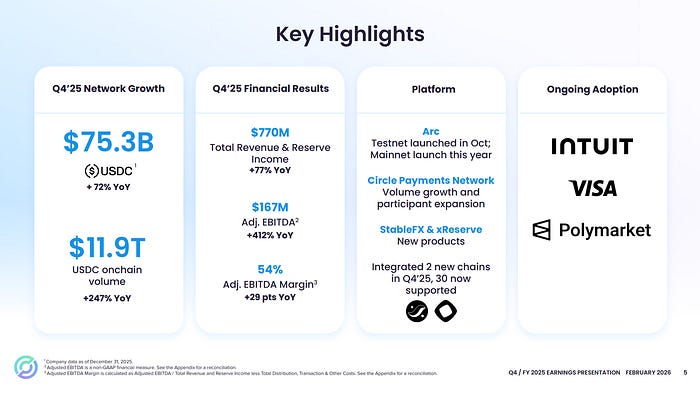
Key Metrics
4Q25 Total Revenue and Reserve Income: $770M (+77% YoY)
FY2025 Revenue: $2.75B (+64% YoY)
USDC Circulation: $75.3B (+72% YoY)
Adjusted EBITDA Margin: 54%
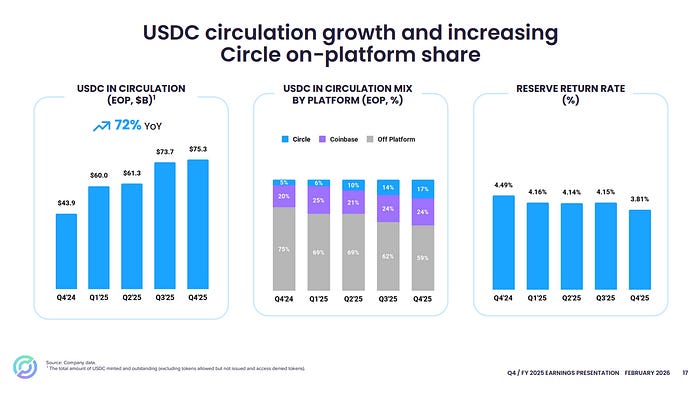
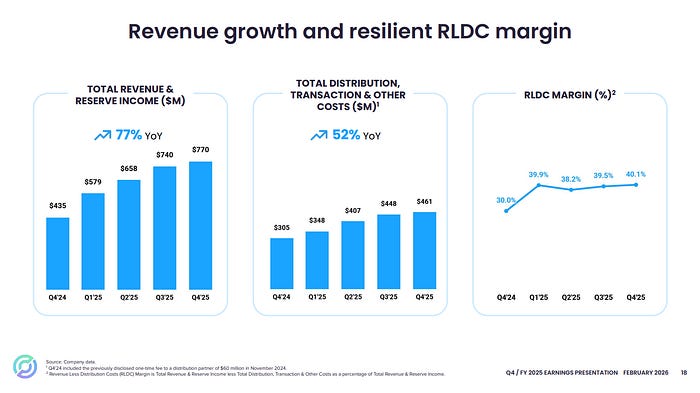
The rapid expansion of USDC supply was the primary driver of revenue growth.
By the end of 2025, circulating USDC reached $75.3B, nearly doubling the company’s original growth target.
More importantly, profitability improved dramatically. Adjusted EBITDA increased more than fourfold year-over-year, indicating that Circle has entered a phase where incremental increases in USDC supply translate into disproportionately higher profits.
2. Revenue Diversification: Moving Beyond Interest Income
Historically, Circle’s revenue has been largely dependent on interest income generated from the reserve assets backing USDC.
However, the company is increasingly expanding its revenue streams through infrastructure and service-based activities.
In 4Q25, Other Revenue reached $37M, compared with just $2.4M in the same quarter the previous year.
This category includes:
Blockchain network partnership revenue ($24.7M)
Validator rewards from operating a Super Validator on Canton Network ($12.2M)
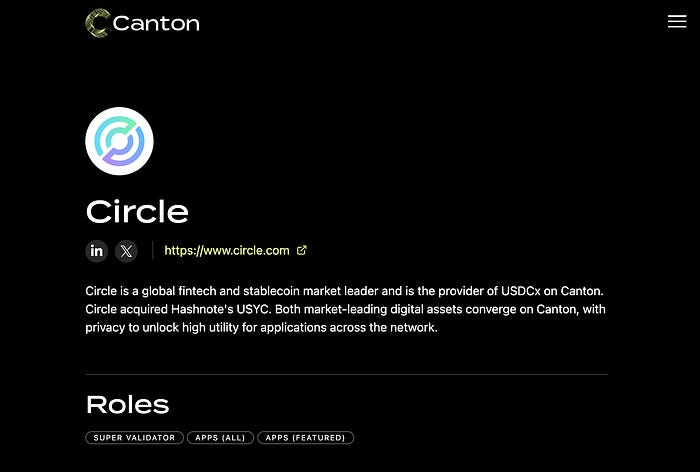
These new revenue streams suggest that Circle is gradually evolving beyond stablecoin issuance toward becoming a participant in blockchain infrastructure itself.
Another important development is the increasing share of USDC hosted directly within Circle’s own platform.
As of 4Q25, approximately 17% of total USDC supply ($12.5B) is now hosted internally, reducing distribution costs paid to external partners.
As a result, Circle’s Revenue Less Distribution Costs (RLDC) margin increased to 40.1%.
3. Drivers Behind the Recent Stock Re-Rating
Circle’s recent stock rally reflects more than just strong earnings performance.
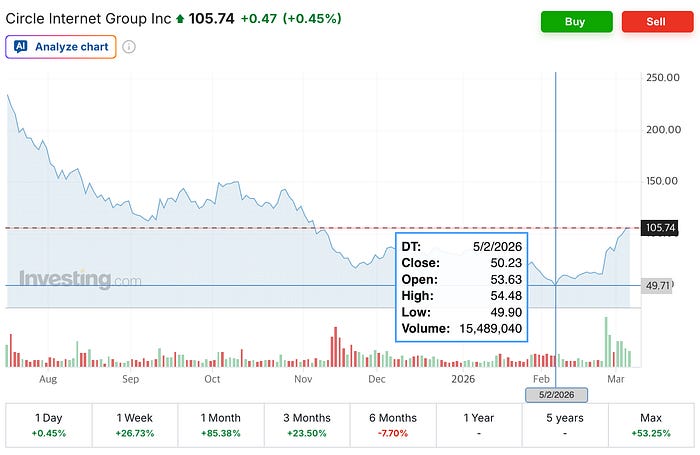
Investors appear to be reassessing the company’s long-term strategic role within the global financial system.
Institutional Adoption
Large financial institutions and payment networks are increasingly experimenting with stablecoin settlement systems.
For example, Visa has implemented infrastructure that allows U.S. issuers and acquirers to settle transactions using USDC 24 hours a day, seven days a week.
Circle has also partnered with Intuit, further demonstrating the potential role of stablecoins in real-world commercial payments.
These developments suggest that USDC is gradually evolving beyond a trading instrument into a functional settlement asset for digital commerce.
Expansion of Circle’s Infrastructure
Circle is also developing additional infrastructure around USDC.
The company’s Arc platform enables institutions to build tokenized financial applications on a dedicated blockchain infrastructure. Currently, more than 100 institutions are participating in the Arc testnet.
Meanwhile, the Circle Payments Network (CPN) includes 55 financial institutions, with the capacity to process roughly $5.7B in annual transaction volume.
More broadly, these initiatives reflect Circle’s ambition to position USDC not just as a digital dollar, but as the settlement layer for internet-native finance.
Together, these initiatives position Circle as a potential settlement infrastructure provider, rather than merely a stablecoin issuer.
4. Regulatory Catalysts: The Strategic Importance of the Clarity Act
Recent regulatory developments in the United States could significantly reshape the stablecoin market.
Following the passage of the GENIUS Act in July 2025, policymakers are now debating the Clarity Act, which aims to clarify the regulatory classification of digital assets.
If enacted, the legislation could provide several strategic advantages for Circle.
Potential Implications
Legal classification
Stablecoins would likely be treated as payment instruments or commodities, rather than securities.
Bank adoption
The law could provide a pathway for banks regulated by the Federal Reserve and the Office of the Comptroller of the Currency to use stablecoins as settlement assets.
Federal Reserve master account access
Although not guaranteed, regulatory clarity could eventually allow compliant issuers to gain direct access to Federal Reserve master accounts, reducing reliance on commercial banking intermediaries.
Cash-equivalent accounting status
The legislation may also allow compliant stablecoins to be treated as cash equivalents on corporate balance sheets, potentially unlocking significant institutional demand.
5. USDC vs USDT: Transparency vs Liquidity
The global stablecoin market is effectively dominated by two major issuers:
Circle Internet Group — USDC
Tether — USDT
Tether still maintains more than 72% market share, making it the dominant player in the space.
However, the two assets operate under very different strategic models.
Tether’s Strategy
Tether reported over $10B in net profit in 2025, driven in part by a more aggressive reserve allocation strategy that includes:
Bitcoin holdings
Gold reserves
Venture investments
Circle’s Strategy
Circle follows a much more conservative approach, investing 100% of USDC reserves in cash and short-term U.S. Treasuries.
While this may generate lower returns during bullish cycles, it strengthens Circle’s position in terms of transparency, regulatory compliance, and redemption stability.
On-Chain Activity
Interestingly, although USDT still dominates market capitalization, transaction data suggests that USDC is rapidly gaining ground in real economic activity.
As of 4Q25, USDC accounted for roughly 47% of total stablecoin transaction volume, reflecting strong adoption across DeFi, payments, and on-chain financial infrastructure.
Key Takeaways
Circle’s earnings highlight the operating leverage embedded in the stablecoin issuance model.
Regulatory developments such as the Clarity Act could significantly strengthen the competitive position of compliant issuers like Circle.
While Tether still dominates market share, the stablecoin market may gradually split between trading liquidity assets (USDT) and financial infrastructure assets (USDC).
Investors are increasingly reassessing Circle not simply as a crypto company, but as a digital dollar infrastructure provider.
Conclusion
Over the course of 2025, Circle succeeded in achieving both strong financial growth and the establishment of a regulatory foundation for its business model. The company’s 54% adjusted EBITDA margin in the fourth quarter suggests a level of operational efficiency more commonly associated with high-growth software companies.
The potential passage of the Clarity Act would represent more than regulatory approval. It could effectively formalize the role of USDC as a channel through which global capital liquidity enters the digital economy.
As a result, investors are increasingly beginning to view Circle not simply as a crypto issuer, but as a new type of financial institution built for the internet era.
If Circle successfully executes on its 2026 guidance and launches the Arc mainnet as planned, the company could emerge as a significant force not only within digital assets but across the broader global fintech landscape.
In that sense, Circle may now be entering a phase that goes beyond stablecoins, positioning itself as a foundational layer for internet-native financial infrastructure.
Legal & Disclosures
Disclaimer
This publication is for informational and research purposes only and does not constitute investment, financial, or legal advice, nor a recommendation to buy, sell, or hold any asset.
All analysis reflects publicly available information and reasonable assumptions at the time of writing and may change as market or regulatory conditions evolve.
This research was prepared independently and without compensation from any issuer or affiliated party. Readers are solely responsible for their own investment decisions. Exilist assumes no liability for any losses resulting from reliance on this publication.
Terms of Use
Exilist permits the fair use of its research materials for non-commercial and informational purposes, provided that the original meaning and analytical context are not altered.
When referencing or citing this publication, clear attribution to Exilist is required.
Any republication, translation, restructuring, commercial distribution, or derivative use of this material, in whole or in part, requires prior written consent from Exilist.
Unauthorized commercial use, misrepresentation of analytical conclusions, or redistribution without proper attribution may result in legal action.