



Introduction
The success or failure of IP tokenization does not depend on whether tokens can be issued. Companies holding valuable intellectual property must be willing to participate, creators must be able to raise capital, and investors and users must receive corresponding rights and rewards. Blockchain can support this process, but it cannot create the underlying reason for a transaction to take place.
Soneium, developed by Sony and Startale Group, is working to address this challenge in the entertainment industry. Its recently announced partnership with DayOneDream represents an effort to connect K-pop IP and related revenue streams to onchain financial structures. The goal is to expand both funding opportunities for creators and economic participation for fans and investors.
However, the challenges are as significant as the market opportunity. Story, which previously attracted attention as a blockchain specializing in IP, shifted its business focus toward AI training data under the name The Data Foundation this year. Its pivot illustrates that technological capabilities and investment funding do not necessarily guarantee the emergence of a viable market.
What, then, makes Soneium different? The key lies in whether Soneium can connect companies supplying content, organizations managing rights, services engaging fans, and businesses structuring investment products. If these connections function effectively, IP tokenization could evolve beyond an experiment in selling new digital products and lead to changes in how content is produced and monetized.
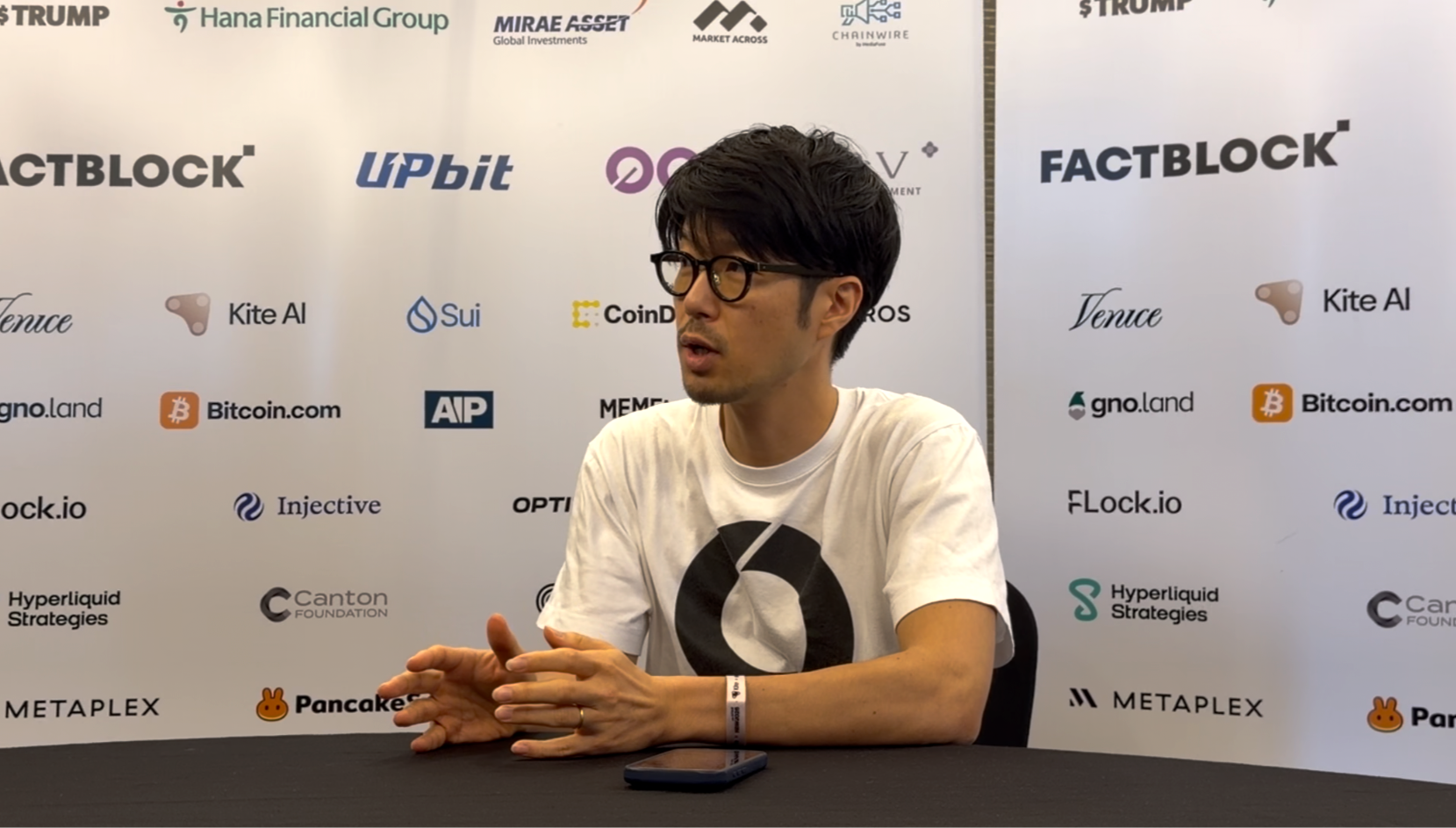
An interview with Yuji Kumagai, Head of Soneium Protocol, provides insight into this strategy. Rather than attempting to establish a massive IP financial market from the outset, Soneium intends to create smaller success cases in music and character-related IP before expanding. The most compelling initial path is not to divide and sell ownership of famous IP to the public, but to provide new financing and monetization tools for projects backed by real businesses and cash flows.
1. Soneium Aims to Change the Flow of Capital, Rather Than How IP Is Owned
“We want to provide creators with opportunities to raise funding on a more global scale when developing new works.”
— Yuji Kumagai, Head of Soneium Protocol
When explaining IP tokenization, Yuji’s first point was not ownership, but financing. The objective is to offer creators alternatives to traditional funding methods while giving fans and investors opportunities to participate in the economic value of entertainment that was previously difficult to access.
This direction is connected to Soneium’s original vision. When Sony announced Soneium’s development in August 2024, it presented the goal of creating a world where the use of Web3 becomes part of everyday life. Even then, Sony stated that it would explore mechanisms for protecting creators’ rights, returning revenue to creators and fans, and developing services utilizing Sony’s businesses and IP. Soneium launched its mainnet in January 2025.
The recent emphasis on IP financing therefore does not represent a departure from the original vision. Rather, the broad goal of connecting creators and fans is becoming a more concrete business question: through what mechanisms can creators’ economic conditions be improved?
Content production requires capital upfront, while revenue is generated later. Startale Group, Soneium’s co-developer, and Japanese entertainment company TWIN PLANET identified this timing gap as a central challenge in their 2025 partnership announcement. They outlined plans to explore production financing, and rights management.
Addressing this problem does not necessarily require selling the entirety of a copyright. Depending on the contractual structure, funding can also be raised by utilizing a portion of revenue from a specific project or by financing against receivables generated by a business. WAVIST’s previous transaction, for example, involved a bond structure backed by performance-related cash flows.
An important distinction must be made regarding the meaning of IP tokenization. Holding a token associated with a work, possessing a license to use that work, and having the right to receive revenue from a particular business are three different things. Purchasing an NFT does not automatically mean acquiring the copyright to the underlying work.
The economic opportunities Soneium seeks to create begin with determining which rights can be offered and under what conditions. The intended structure allows creators to secure necessary funding without surrendering all their rights, while participants receive economic value within the scope explicitly defined by contracts.
The objective is not to turn IP into tokens, but to enable IP to become capital for future creative activity. From this perspective, Soneium’s real competitors are not limited to other blockchains. They also include traditional production advances, loans, and project investment structures.
2. The Challenge Is Not Technology, but Giving Rights Holders a Reason to Participate
The barriers in this market do not disappear simply because the technology improves. Companies holding IP have reasons to control how their assets are used and how their brands are represented. For them to adopt new infrastructure, they must be able to generate additional benefits while maintaining that control.
Story’s pivot demonstrates this challenge. In 2024, Story developer PIP Labs raised $80 million in a Series B funding round led by a16z. In 2025, it launched a mainnet designed for IP registration and licensing. However, when announcing its transition to the DATA Foundation in June 2026, the company explained that rights holders of high-value music, gaming, and brand IP wanted to retain control, creating conflicts with an open licensing model. By contrast, stronger demand had been identified in AI training data.
The case illustrates a company that made progress in technological implementation and fundraising but could not sufficiently validate its original business hypothesis of general-purpose IP infrastructure through market demand, ultimately shifting its focus to a different market.
Soneium’s potential differentiation lies precisely in this business-related barrier. According to the official ownership structure, Sony Block Solutions Labs, the company leading Soneium’s development and launch, is owned 90% by Sony Group and 10% by Startale Group. In other words, Soneium is not an external project merely borrowing the Sony name. Its development has been led by a company in which Sony Group holds a controlling stake.
Persuading content companies from outside the industry and structuring partnerships within an established network of shared business interests represent different starting points.
Yuji also emphasized the importance of allowing rights holders to make their own decisions.
“We believe that creators should always have the right to make these decisions. If creators want to share those rights with fans or investors, blockchain can make that possible.”
This statement provides a useful framework for understanding Soneium’s strategy. Rather than forcing rights holders to adapt to new technology, the goal is to create new types of transactions within boundaries they can accept. Limited licenses for specific works, financing for individual projects, and participation benefits for fans can each be structured under different conditions.
Nevertheless, proximity to the entertainment industry does not guarantee success. What matters is whether these relationships translate into real services and transactions. Soneium already has several implementation cases that can be used to evaluate its progress.
3. Real Industry Touchpoints Across Rights Management, Fandom, and Distribution
Rights Management: Blockchain Enters JASRAC’s Operations
In April 2025, the Japanese Society for Rights of Authors, Composers and Publishers (JASRAC) migrated the blockchain used for the proof-of-existence function of its music information management system, KENDRIX, to Soneium. The migration moved the recording of registered music file hashes from a private blockchain to a public blockchain.
The significance of this case goes beyond securing a partnership with a prominent institution. It shows that Soneium has begun to be used in actual operations related to music rights management.
However, the confirmed scope is limited to the proof-of-existence function. JASRAC’s entire copyright portfolio and royalty operations have not been transferred to Soneium. The current achievement is Soneium’s entry into rights management operations. The next challenge is determining how far this can expand into licensing and settlement.
Fandom: Services That Change Existing Fan Behavior
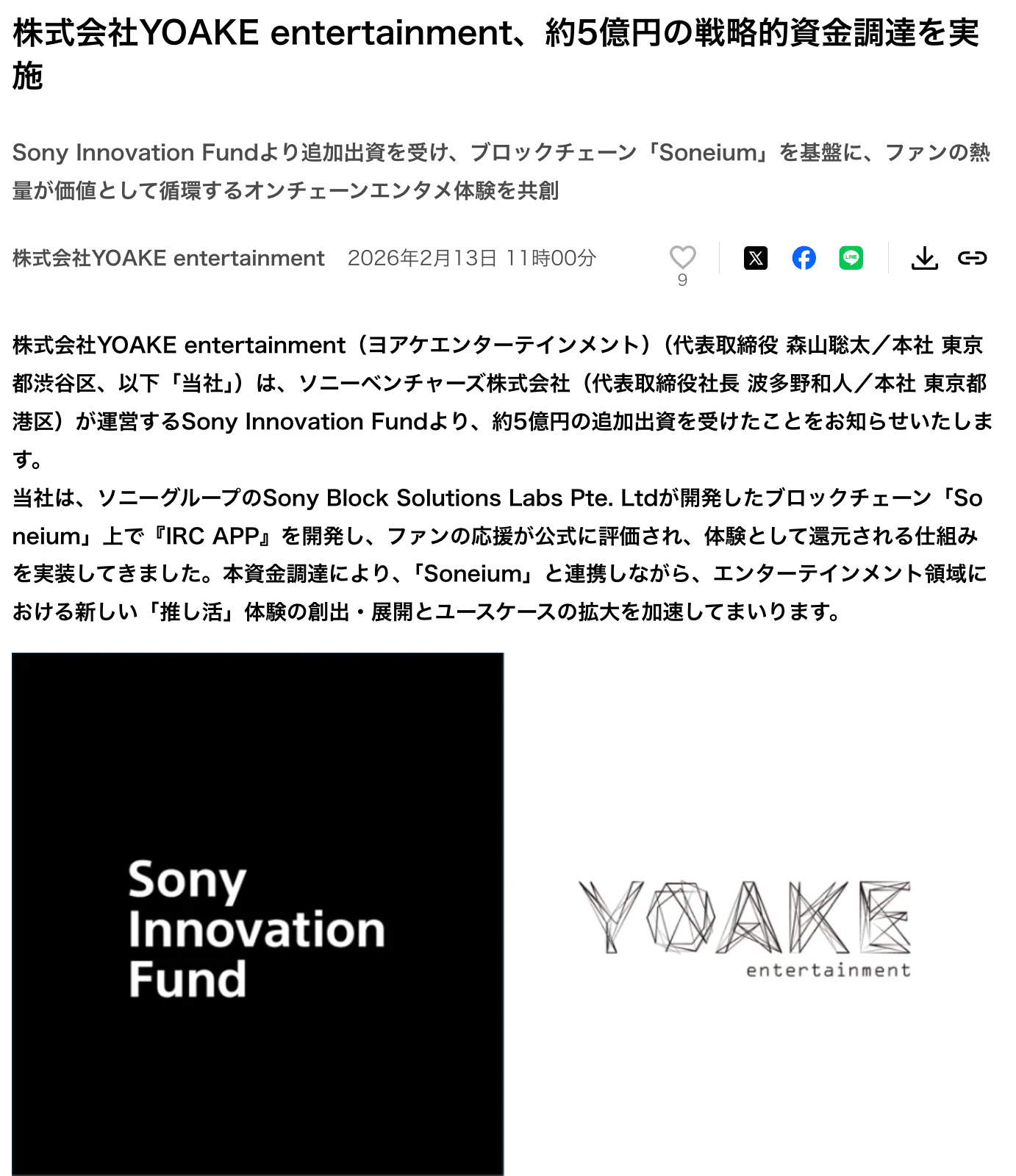
YOAKE entertainment is an important player in Soneium’s engagement with fans. YOAKE is an entertainment joint venture involving ASOBISYSTEM, TWIN PLANET, W TOKYO, Y&N Brothers, and other companies. Through its Soneium-based IRC APP, YOAKE records fan support activities and connects them to event benefits. In February 2026, it received approximately ¥500 million in additional investment from Sony Innovation Fund.
IRC APP is the official application of IDOL RUNWAY COLLECTION, an idol and fashion event. The March 2026 event featured Nogizaka46, FRUITS ZIPPER, CANDY TUNE, and other performers. Activities within the app were linked to benefits such as priority admission and seat upgrades.
Early data on behavioral changes has also been disclosed. YOAKE reported that among low-activity users, who accounted for 25% of its user base, the average frequency of social media posting increased from once every 20 days before the app’s introduction to once every two days afterward.
These figures are based on the company’s own analysis and do not isolate the effect of blockchain technology itself. Nevertheless, they provide preliminary evidence that existing fans used a service connected to tangible benefits and changed their behavior.
From a business perspective, the important point is that fans do not need to be convinced of blockchain’s value before using the service. They use it to support their favorite artists more actively or gain access to better event experiences. The technology serves to connect those activities with rewards and benefits.
Distribution: Bringing Digital Products to Existing Consumer Platforms
Commercialization efforts involving well-known IP are also underway. S.BLOX conducted an NFT campaign on Soneium featuring characters from Ghost in the Shell, while YOAKE collaborated with OpenSea to sell official NFTs related to the theatrical release of The Seven Deadly Sins.
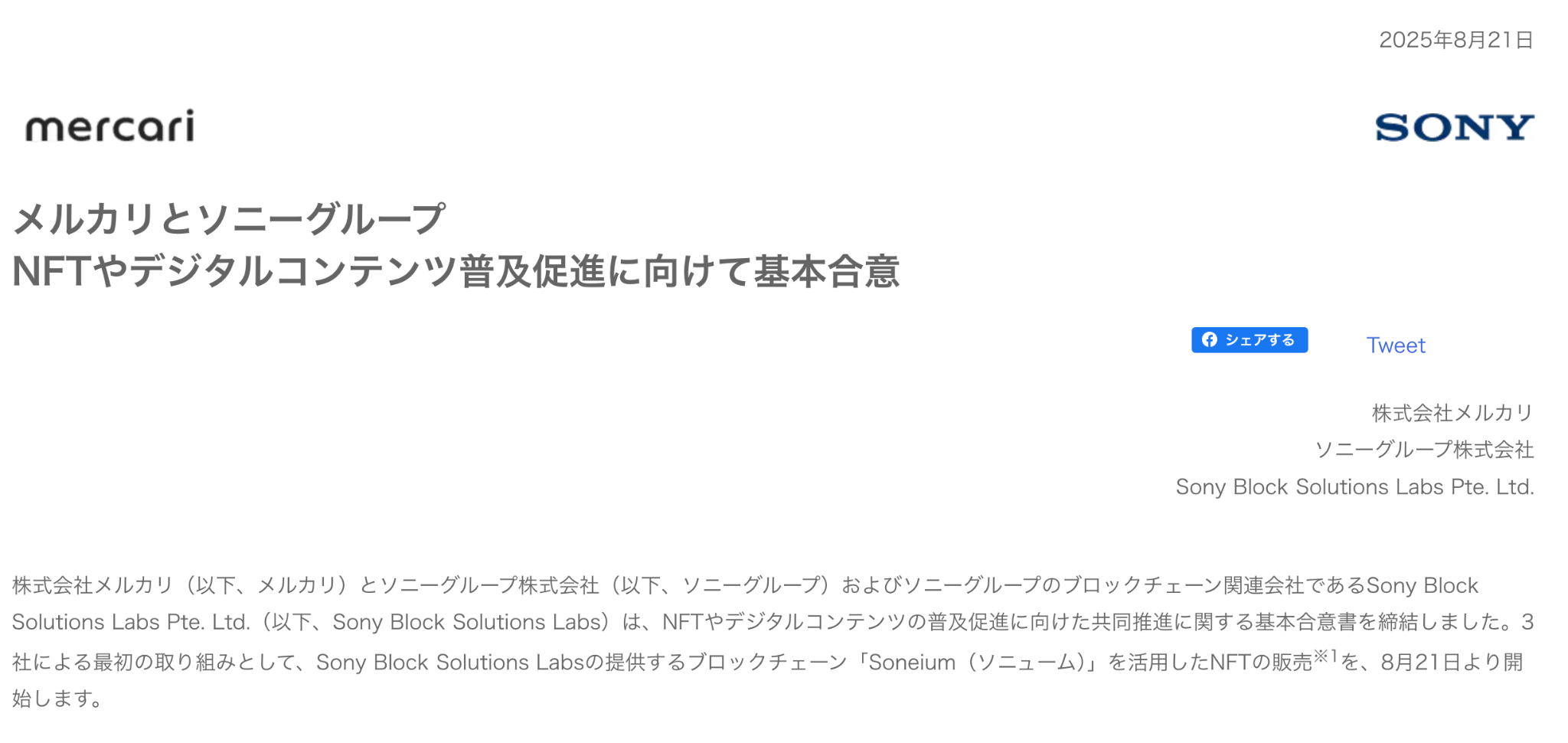
An even more significant distribution case involves Mercari. In August 2025, Mercari, Sony Group, and Sony Block Solutions Labs entered into a basic agreement to promote digital content adoption. On the same day, they began selling NFTs associated with “@JAM EXPO 2025” using Soneium. This was a case in which a partnership announcement was accompanied by actual product sales.
Yuji also identified distribution as a central challenge during the interview.
“Distribution after a product has been created has been one of the biggest problems in the cryptocurrency market for more than five years.”
Connecting the various touchpoints Soneium has established reveals its broader strategy. Rights management organizations handle information related to creative works, entertainment businesses connect content with fan communities, and consumer platforms distribute actual products.
This provides evidence that Soneium is not merely infrastructure waiting for demand to emerge from outside the content industry. It has a foundation for embedding services into existing business relationships and consumer activities.
However, the achievements demonstrated so far primarily involve rights records, fan engagement, and digital product distribution. They should not be collectively treated as proof of successful IP financing.
The next step is to demonstrate how much these touchpoints contribute to creators’ financing and the actual distribution of revenue.
4. The Initial Goal Is Not Financing Major IP, but Completing small and mid-sized Projects
“We want to start by creating small and mid-sized success cases without taking on significant risks. That is our short-term goal for 2026.”
Yuji identified music and characters as Soneium’s short-term priorities in terms of IP Tokenization. Rather than beginning with capital-intensive areas such as games or animated films, the plan is to validate business structures at a relatively smaller scale. During the interview, he explained that Soneium intends to launch a limited number of IP tokenization projects this year and expand their scale the following year.
This approach is reasonable. Even if Soneium secures major IP assets from the outset, complex rights structures and long investment periods could require substantial time and expense before the viability of the business model can be assessed. By contrast, projects with clearly defined scopes may make it relatively easier to validate an entire cycle, from fundraising and business execution to settlement.
DayOneDream and WAVIST are the partners helping translate this strategy into practice.
DayOneDream is a group operating K-content businesses across music production and publishing, artist IP, live performances, and related areas. WAVIST is a tokenization platform that uses this business foundation to structure cash flows from performances and content into investment products, while supporting investor connections and post-issuance management.
WAVIST is operated by Pledge, and the roles of the issuers of individual products and the platform itself are distinct.
WAVIST’s previous transaction illustrates what IP financing can mean in practice. According to materials published in June 2026, it completed the issuance, principal and interest repayment, and token burning of a $1 million bond backed by cash flows from Korean performances.
A special purpose vehicle issued the bond, supported by a group-level guarantee, while the token records were maintained on Ethereum.
However, this was an existing WAVIST transaction disclosed by the company and cannot be considered a result directly attributable to Soneium. Nevertheless, it is meaningful that a business with experience managing a financial product through repayment, rather than merely planning an issuance, is joining the Soneium ecosystem.
What Soneium needs to contribute is more than token issuance functionality. It must provide additional IP supply, user touchpoints, investor distribution, and connectivity between services to existing product structures.
The partnership announced in September aims to enable precisely this expansion. However, the announcement did not specify the rights or issuance terms of the first product expected to launch on Soneium.
Based on this case, the initial market is likely to differ from a market in which copyrights to famous artists are sold directly to fans. A market that financially structures performance or content projects with identifiable revenue and connects them with suitable capital may emerge first.
Fans contribute to the value of IP through consumption, promotion, and participation, while investors evaluate financial risks according to separate criteria. These roles may overlap, but they do not necessarily need to be fulfilled by the same people.
WAVIST likewise distinguishes between fan participation products that do not provide financial returns and investment products that require separate contracts and eligibility verification.
Leveraging the power of fandom does not mean turning every fan into an investor. A structure in which fan participation generates business demand and validated businesses attract capital offers a more sustainable starting point.
5. Stablecoins: Liquidity Infrastructure That Keeps the IP Economy Moving
Financing alone does not complete the economic cycle for creators. After a work is produced, it needs to be used more widely, and compensation must be paid for that usage. Soneium’s efforts to pursue IP registration, licensing, and royalty distribution can be understood in this context.
“The first is IP registration, recording who created the original work and when. The second is what we call the IP graph.”
Yuji described a structure that connects original works, derivative creations, and AI-generated content, while distributing royalties to the relevant creators and participants.
The concept extends beyond recording the existence of a work. It seeks to connect usage relationships with economic compensation.
ERC-8432, which Soneium recently expressed its intention to support, represents one potential technical foundation for this approach. The proposed standard would allow independent IP registration systems to record and query assets, licensing terms, and usage agreements in a common format.
The draft was published in September 2026, and Soneium announced its support plan on October 6.
Its business significance lies in reducing the burden of repeatedly interpreting different rights information when connecting individual services. For example, if a video production service or AI agent could check the usage conditions and contractual status of a music track in a standardized way, the process leading to commercial use could become simpler.
However, the proposed standard does not automatically establish the authenticity of legal rights or resolve royalty payments. Its authors explicitly placed payments, royalties, and legal enforcement outside the scope of the core standard. Businesses adopting the standard would still need to build their own mechanisms for rights verification and settlement.
Once the conditions and agreements governing IP usage can be verified, the next step is to make payments and distribute revenue.
This is also why Yuji emphasized stablecoins. He sees them as a means of connecting economic activities related to content onchain, from capital contributed by investors participating in IP products to royalties paid to creators.
The assets he mentioned were the US dollar-based Startale USD (USDSC) and the Japanese yen-based JPYSC.
USDSC was introduced by Startale Group in December 2025 using the platform of stablecoin infrastructure company M0. It was designed for use in transactions, rewards, and other activities within Soneium and Startale App.
JPYSC is a yen-pegged, trust-based stablecoin jointly developed by SBI Holdings and Startale Group and issued by SBI Shinsei Trust & Banking Co., Ltd. It represents an effort to build infrastructure operating seamlessly across traditional financial systems and blockchain networks.
Therefore, yen-based settlement for global IP should not be regarded as an already established achievement. Rather, it should be viewed as a potential application that can expand once the necessary distribution infrastructure is in place.
Yuji’s vision extends beyond improving settlement efficiency. He explained that stablecoins could serve as an entry point connecting fans unfamiliar with cryptocurrency to onchain services.
“In that case, stablecoins could become the entry point through which people hold tokens for the first time.”
One example would involve depositing stablecoins into a vault associated with a particular artist and receiving benefits such as early access.
The important aspect of this model is that the motivation for participation is not limited to investment returns. Fans may participate to access experiences and benefits related to creators they support, encountering onchain assets and services in the process.
From this perspective, stablecoins serve both as a settlement mechanism for IP finance and as a tool connecting fan experiences.
Financing increases opportunities to produce new works, licensing expands opportunities to use those works, and settlement returns the resulting economic value to creators and participants.
What Soneium seeks to establish is not merely a system that turns IP into investment products, but a structure in which capital, usage, and rewards continuously flow around that IP.
The necessity of blockchain must also be evaluated through these connections. If a business involves only one company and a small number of counterparties, traditional contracts and databases may be sufficient.
The value of shared infrastructure becomes greater when multiple rights holders, platforms, investors, and users need to verify one another’s records and conduct repeated transactions.
Soneium’s long-term opportunity lies less in a one-time IP issuance and more in recurring transactions where multiple services can legally use the same IP and pay for that usage.
AI should likewise be viewed not as a separate buzzword, but as a potential customer segment that could expand this demand for IP usage.
6. Soneium Has Potential, but Industry Connections Must Translate Into Economic Advantage
Based on currently available public information, Soneium has established the conditions necessary to enter the IP business.
It has entered rights management operations, secured services used by existing fan communities, and conducted actual sales through a consumer distribution platform. It has also connected with a partner experienced in structuring financial products and managing them through repayment.
It would therefore be difficult to characterize Soneium as merely an abstract IP concept without real implementation.
At the same time, these examples cannot be combined to conclude that IP financing has already been validated. Some components of the business are functioning, but the repeatable economic viability of an integrated model built on Soneium remains to be demonstrated.
Three developments are necessary to evaluate its potential for success.
First, creators’ financing terms must actually improve.
Soneium must enable creators to access a broader investor base, shorten fundraising periods, or retain a greater scope of rights than existing financing methods allow.
Even if blockchain transaction fees are low, the economic advantage will be limited if total costs, including legal, structuring, and distribution expenses, are higher.
What matters is not the fact that capital was raised onchain, but how the financing terms improved because it was raised onchain.
Second, post-issuance performance must lead to subsequent transactions.
Payments promised to investors must be fulfilled, revenue and expenses must be verifiable, and the same business operators must choose to use the structure again for future projects.
One successful repayment is only the starting point. For this to become a new business model, contracts and verification procedures must be reusable across multiple projects.
Third, fandom services and financial products must create additional value for each other.
Fan participation needs to translate into actual sales and repeat engagement. Financing must enable the production of new content, which in turn attracts users.
High levels of fan activity alone do not prove investment demand or profitability. Fan engagement data may provide supporting information for understanding demand, but it cannot replace cash flow verification.
One particularly difficult challenge Soneium must address is selecting suitable projects.
Businesses that can already secure favorable financing through traditional channels may have little reason to adopt a new structure.
Conversely, accepting projects simply because they struggle to obtain conventional financing could increase investment risks.
This is where industry expertise becomes important.
Rather than focusing solely on the popularity of IP, Soneium must understand production and distribution structures, the scope of rights, actual demand, and the counterparties responsible for settlement.
The potential strength of Soneium and its entertainment partners should not end with bringing recognizable content into the ecosystem. It must also be used to determine which businesses can successfully be connected with financial structures.
If these conditions are met, the most realistic initial success would likely be a production financing model focused on specific segments.
The path would involve repeatedly financing and settling projects in areas with definable business scopes, such as music, live performances, and characters, before extending validated contracts and operational models to other projects.
This approach is consistent with Yuji’s strategy of building success through smaller initial cases.
Conversely, if official NFTs and one-off campaigns continue to increase without improving creators’ financing terms or revenue from IP usage, Soneium may remain a useful infrastructure for fan marketing.
That would still constitute a business, but it would represent a different level of achievement from the onchain entertainment economy envisioned in this interview.
Conclusion: A Market Where Valuable IP Becomes Capital for the Next Creation
“Technology is just technology. It is one tool, and other technologies can also be used. Ultimately, the goal is to empower creators.”
Yuji’s statement provides the most direct criteria for evaluating Soneium’s success.
What matters is whether creators can produce new works more easily, whether rights holders can generate additional revenue while maintaining control, and whether participants receive clearly defined rights and rewards.
Soneium’s potential lies in the fact that it is not attempting to create an entirely new market disconnected from the content industry.
Instead, it is connecting blockchain to existing rights management, fandom, distribution, and financial businesses.
This allows Soneium to begin with smaller transactions that businesses are willing to accept, without requiring all IP to become openly accessible from the outset.
If successful, the impact could extend beyond financing individual projects.
As experience accumulates through repeated contracts and settlement processes, there may be opportunities to reduce the costs of evaluating and executing subsequent projects.
As a result, content that previously struggled to access financing because of its limited scale or high operational burden could gain access to new sources of capital.
This represents a potential path for Soneium’s expansion.
However, it remains a prospect rather than an established outcome.
Soneium must connect its existing industry touchpoints to actual financial and licensing transactions and demonstrate that those transactions offer advantages over traditional methods.
Sony possesses the business conditions necessary to overcome the limitations of IP tokenization.
Yet this advantage will not be realized simply because Sony owns IP or understands the industry. It will materialize only when rights holders are given compelling reasons to participate.
The outcome Soneium needs to create is not more IP tokens.
It is a repeatable market in which valuable IP gains access to new capital, and the works produced with that capital generate revenue and opportunities for further creation.
This content is analysis material for information and research purposes and is not intended to recommend buying, selling or holding specific assets (stocks, tokens, etc.) or to replace investment judgment. All opinions and interpretations included in the text are based on public information and reasonable assumptions at the time of writing and may change depending on future market conditions or changes in policies and regulations.
This research was conducted independently without receiving any financial compensation, sponsorship, or compensation in connection with the writing of this article from the project or its affiliates. However, the author or affiliated organization may have had a paid business relationship with the project in the past, and thus a conflict of interest may exist. The opinions and interpretations contained in the text are based on the independent judgment of the author.
The final responsibility for investment decisions lies entirely with the reader, and the author assumes no legal responsibility for investment results based on this content.
© 2026 Exilist Inc.